Play Cubes
Cubes Slot Game Review
Twenty five coloured squares do most of the work in Cubes, where Hacksaw Gaming turns a 5x5 board into an expanding cluster game. The grid can grow as potential combinations connect, eventually reaching 11x11, while a multiplier sits in the centre cube waiting to become useful. Free Spins add sticky behaviour to one random colour, and Color Blast becomes possible once a cluster gets particularly ambitious. Minimalist certainly applies to the artwork. The mechanics didn't receive the memo.
Theme & Graphic
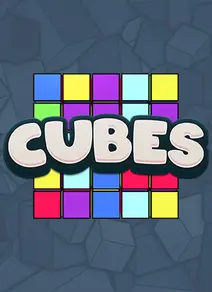
Cubes strips the visual design back to six colours, square blocks and a dark geometric background. There are no characters, landscapes or treasure chests competing for attention. Green, yellow, red, light blue, purple and dark blue cubes fill the board, with the grid itself becoming the main visual feature as new rows and columns appear.
That simple approach gives Cubes a distinctive place among online slots. Winning clusters physically increase the board size, so much of the animation comes from cubes shifting, rearranging and filling newly created spaces. The soundtrack is similarly restrained, using a steady rhythmic beat rather than dramatic feature music.
We rather like how confidently plain the whole thing looks. Hacksaw Gaming has essentially made colourful squares the cast, scenery and special effects department, which must've kept the costume budget manageable.
Payout Table
Every colour uses the same potential payout structure. Instead of conventional symbol combinations, the value depends on the number of connected cubes in a qualifying cluster.
- Middle Multiplier: The centre cube contains a multiplier during every base game round. If that cube becomes part of a potential winning cluster, the displayed multiplier applies to that cluster and increases by 1 for every cube involved, up to x22.
- Coloured Cubes: Green, yellow, red, light blue, purple and dark blue cubes all use the same payout scale. Five or more connected cubes of one colour are needed to form a qualifying cluster.
Bonus Features
Middle Multiplier
Every base game round places a multiplier inside the centre cube. The multiplier only becomes relevant when that position is included in a qualifying cluster.
Each cube belonging to that cluster adds 1 to the displayed multiplier, with the value able to reach x22. The multiplier then applies to the corresponding potential cluster payout.
The mechanic becomes more interesting as the grid expands because larger connected groups can eventually reach the middle position from several directions.
Free Spins
Free Spins activate after five differently coloured qualifying clusters have been collected. The CUBES display above the board tracks this progress.
The feature can provide up to 10 Free Spins and randomly selects one cube colour. Potential wins formed with that colour remain sticky throughout the round.
Grid size is sticky as well. If the board has expanded before one Free Spin finishes, the larger layout carries into the next spin rather than resetting to 5x5. This gives later spins more space for larger clusters and additional connections.
Color Blast
Color Blast becomes available during Free Spins. Reaching a cluster containing 70 cubes triggers a potential instant result worth x2500 of the bet.
The feature depends on the expanded grid and sticky behaviour established during Free Spins, so building one colour across a larger portion of the board becomes particularly important.
Spin Mechanics
Cubes starts on a 5x5 grid and uses cluster wins rather than paylines. A potential combination requires at least five symbols of the same colour connected horizontally or vertically.
Whenever a new cluster appears, or an existing cluster gains another connection, the grid expands outward. This process can continue until the board reaches 11x11. In the base game, potential payouts aren't resolved until the expansion sequence has completely stopped.
That structure gives Cubes a very different rhythm from reel based online casinos titles. The first 5x5 arrangement is really only a starting point. One connection can increase the board, create new neighbouring symbols and potentially lead to another expansion before the round finally settles.
Similar Slots
A few previously reviewed games make useful comparisons through colourful presentation or unconventional ways of building potential wins.
- Reactoonz Blitzways: Connected symbols and changing grid behaviour make this the closest mechanical comparison, even though the Blitzways system works differently.
- RWB Gems: Bright gemstones, compact visuals and a strong focus on colour give this title a similar stripped back visual quality.
- Bubble Works: Candy colours and a secondary prize area make the presentation much busier, but both games rely heavily on simple shapes and colour coding rather than elaborate characters.
Heart Bingo's Opinion
Cubes looks almost aggressively simple, then starts expanding until the original 5x5 board feels like a distant administrative detail. We like that contrast. The coloured blocks are easy to read, while the expanding grid gives a successful cluster more consequence than simply disappearing and being replaced.
The Middle Multiplier is also neatly integrated because its usefulness depends on whether a cluster actually reaches the centre. Free Spins make the structure more interesting again by keeping one colour and the expanded grid sticky.
Our only reservation is that anyone wanting characters, detailed scenery or constant feature animations won't find much of that here. Cubes is very deliberately about geometry and connections. For fans of cluster mechanics and unusual grid behaviour, that's probably the point.